
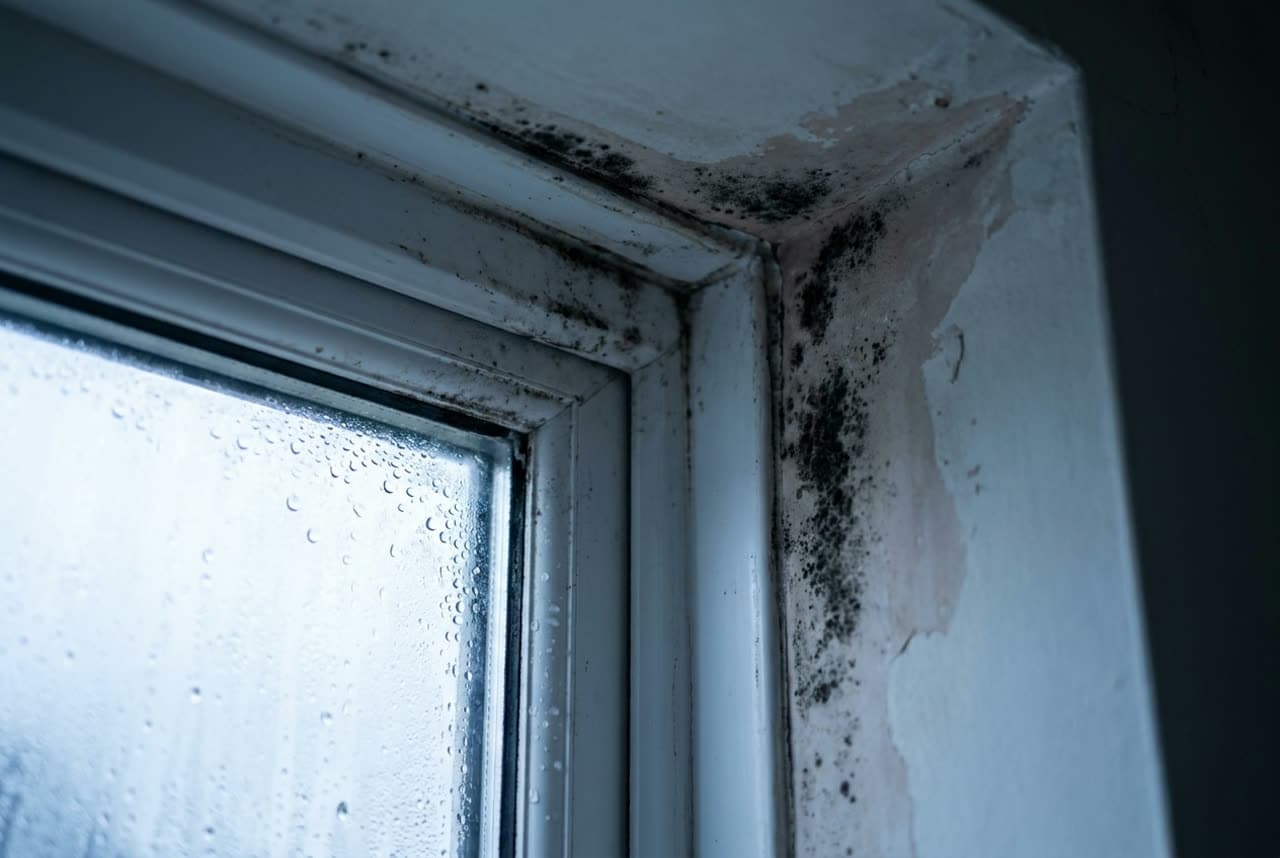
Damp on a wall almost always gets called 'rising damp' — but in our experience across South Manchester, the majority of call-outs labelled rising damp are actually condensation. That matters, because the two problems have completely different causes, and completely different price tags to fix.
What rising damp looks like
Rising damp comes up from the ground through the wall when the damp-proof course has failed or been bridged. The tell-tale signs are a horizontal 'tide mark' up to about a metre from the floor, blown or crumbling plaster low down on the wall, white salt deposits (efflorescence), and skirting boards or paint lifting near the bottom. It stays low — if the damp is up near the ceiling, it isn't rising damp.
What condensation looks like
Condensation shows up as black spotty mould, typically around windows, in room corners, behind furniture on cold external walls, and in bathrooms and kitchens. It's worse in winter, worse in unventilated rooms, and often appears where warm, moist air meets a cold surface. If you're wiping black mould off with bleach every few weeks, you have a condensation and ventilation problem — not rising damp.
Why the difference matters
A chemical damp-proof course and re-plaster to treat genuine rising damp is a proper job costing several hundred pounds per wall. Condensation, by contrast, is usually fixed for far less with better ventilation — an extractor fan, a Positive Input Ventilation (PIV) unit, or an anti-condensation treatment. Being sold a damp-proof course when the real issue is condensation is one of the most common ways homeowners waste money.
How we tell them apart
We never diagnose damp by eye alone. On every visit we use a calibrated damp meter to measure the moisture in the wall and, where needed, check whether the moisture is coming from within the wall or condensing on the surface. That's the only reliable way to know what you're dealing with — and for homeowners that visit and quote are completely free. If it's a cheap fix, we'll tell you.
What condensation proofing actually involves
Condensation proofing is the name most people give to the package of work that stops warm, moist air settling on cold surfaces and turning into black mould. It usually starts with ventilation. An extractor fan in the kitchen and bathroom, ideally a humidity sensing one so it runs when the air is actually damp, removes the moisture at the point it is created. Where mould keeps returning in several rooms at once, a Positive Input Ventilation (PIV) unit in the loft pushes fresh filtered air gently through the whole house and holds the humidity down day and night.
Then there are the cold spots. Anti-condensation coatings and insulated thermal plaster lift the surface temperature of a cold external wall, so moisture stops forming on it. That is often what a back bedroom or a north facing corner needs. We kill and treat the existing mould growth first, because painting over it only buys you a few months before it bleeds back through.
It is work we do regularly in the older terraces and semis around Chorlton, Didsbury, Sale and Whalley Range, where solid walls and blocked up chimneys are common causes. The visit and quote are free, and we will tell you straight whether you need ventilation, insulation, or both.